Forex for beginners, a practical start-from-zero roadmap
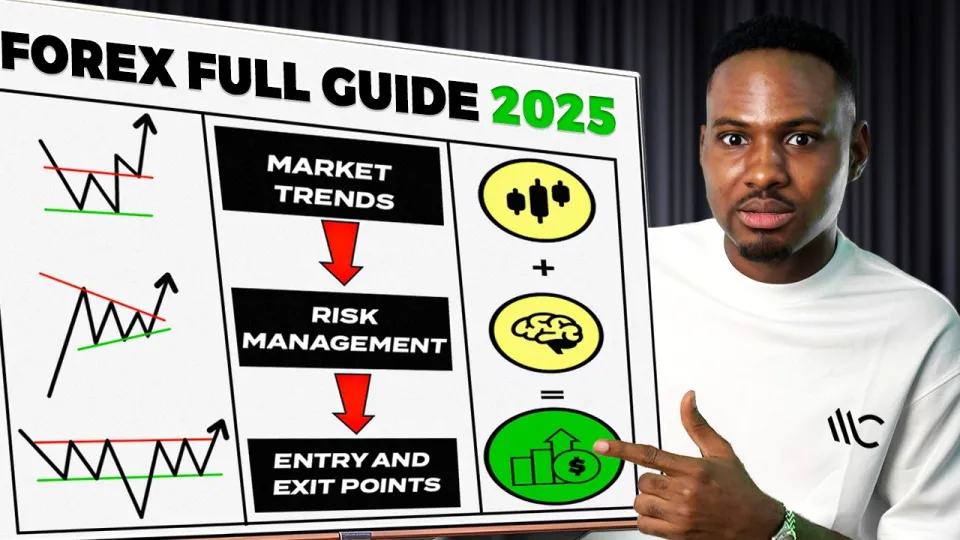
Video: How To Start Forex Trading For Beginners’ 2025 (Full Course)
Want articles like this for your own video to promote it on YouTube and Google? Order them through the Telegram bot @sat_sit_bot. It writes articles around your video, embeds the video and publishes them on popular niche websites (no ads). Free trial — 50 articles.
· based on the channel Jeffrey Benson Forex
Forex for beginners is the process of learning how currency pairs are quoted, choosing a regulated broker and platform such as MetaTrader 5, practising on a demo account, and only then risking small, capped amounts per trade. The core skill is not prediction but position sizing: deciding in advance how much a wrong trade may cost. A structured free course from Jeffrey Benson Forex covers exactly this sequence, and its student plans are listed at Fire Pips FX plans.
What forex actually is and how currency pairs are priced
Forex is a decentralised over-the-counter market where national currencies are traded against each other in pairs, and the price of a pair simply states how much of the quote currency buys one unit of the base currency. In EUR/USD, the euro is the base and the dollar is the quote, so a price of 1.0850 means one euro costs 1.0850 dollars. There is no central exchange; banks, brokers and liquidity providers quote prices continuously, and retail traders access those quotes through a broker.
Three mechanics matter from day one:
- Spread — the gap between bid and ask, which is the broker's built-in cost. On major pairs it is usually fractions of a pip; on exotic pairs it can be many times wider.
- Pip and lot — a pip is the standard unit of price movement (0.0001 on most pairs, 0.01 on yen pairs); a standard lot is 100,000 units of base currency, with mini (10,000), micro (1,000) and nano (100) lots below it.
- Leverage and margin — leverage lets you control a position larger than your deposit, and margin is the capital the broker holds as collateral. Leverage magnifies losses exactly as it magnifies gains, which is why it belongs to risk management, not to strategy.
Currencies are quoted in pairs because every trade is simultaneously a purchase of one currency and a sale of another; there is no way to buy euros without selling something for them.
How the forex market works across sessions and timeframes
The forex market trades 24 hours a day from Monday to Friday, moving through four sessions — Sydney, Tokyo, London and New York — so price is always live somewhere. Liquidity and volatility are not constant: the London session and the London–New York overlap typically produce the tightest spreads and the largest ranges, while the late New York and Sydney hours are quieter and prone to false breaks.
Timeframes serve different jobs. Higher timeframes (daily, 4-hour) show the trend and the levels that matter; lower timeframes (15-minute, 5-minute) are used only for timing an entry inside that context. A beginner who trades a 1-minute chart without a higher-timeframe bias is effectively trading noise. Most of the analysis work should happen before the session opens: mark the previous day's high and low, the obvious support and resistance, and decide which session you will actually trade.
Tools you need before placing a single trade
A working beginner setup consists of a broker account, a trading platform, a charting routine and a journal — nothing more. Extra indicators do not substitute for these four.
- A regulated broker. Check the licence and the regulator (FCA, ASIC, CySEC and similar), the spread on majors, the minimum deposit, and whether the account type suits micro lots. The course author recommends Assex Markets and links registration at https://my.assexmarkets.com/auth/register?partner_code=1699134 — treat any broker recommendation, including affiliate ones, as a starting point for your own due diligence.
- A platform. MetaTrader 5 is the common choice: it handles charts, order types, pending orders and a demo account. Linking the broker account to MT5 is a separate step and needs the login, password and server name from the broker.
- A demo account first. Trade the same instrument, the same session and the same risk rules you intend to use live, for at least a few weeks. A demo that is traded carelessly teaches nothing.
- A trading journal. Record the pair, direction, entry, stop, target, lot size and the reason for the trade. Reviewing twenty logged trades reveals more about your habits than twenty more videos.
Building a basic strategy foundation
A beginner strategy is a written set of conditions for entry, exit and risk — not a feeling about where price is going. The simplest durable structure is trend plus level plus trigger: identify direction on the daily or 4-hour chart, wait for price to reach a meaningful level (prior swing high or low, session high or low, round number), and enter only when a trigger confirms rejection or continuation.
Useful components to define explicitly:
- Market structure — higher highs and higher lows suggest an uptrend; the reverse suggests a downtrend; a range means neither, and ranges punish trend entries.
- Support and resistance — zones where price previously reversed or consolidated, drawn on the higher timeframe and kept to a handful.
- Entry trigger — an engulfing candle, a break and retest, or a close back inside a range, chosen once and applied consistently.
- Stop-loss placement — beyond the level that would invalidate the idea, never at an arbitrary number of pips.
- Take-profit logic — a fixed multiple of the stop (for example 2:1) or the next opposing level, decided before entry.
Risk management is the part that keeps a beginner in the game. Cap risk at 1–2% of equity per trade, calculate lot size from the stop distance rather than from the desired profit, and accept that a losing streak of five trades at 1% costs about 5% — survivable — while the same streak at 10% per trade cuts the account nearly in half.
Placing your first trade and reading the result
A first trade should be small, planned and boring: micro lots, one instrument, one setup from your written rules. The mechanical sequence is: confirm the higher-timeframe bias, wait for price to reach the level, check the trigger, set the stop beyond invalidation, size the position so the stop equals 1% of equity, place the order with stop and target attached, then leave it alone until one of them is hit.
After the trade closes, the review matters more than the outcome. A winning trade taken outside the rules is a bad trade that got lucky; a losing trade that followed the plan is a good trade. Log both, and look for patterns — trading outside your chosen session, moving stops, adding to losers, revenge trading after a loss. These are the mistakes the course flags as the ones that end beginner accounts, and they are behavioural, not analytical.
Common beginner questions and doubts
Most beginner doubts repeat across every comment thread under full courses, and they deserve direct answers.
- "How long until I am profitable?" There is no fixed timeline; the realistic marker is a demo or small live account showing a consistent process over dozens of trades, not a number of months.
- "Can I copy someone else's trades instead?" Copying signals removes the learning, not the risk: you inherit the drawdown without the context. The author offers a free daily signal channel at https://t.me/firepipsignals and a premium group via https://t.me/jeffreybenzhelpbot, but signal following should be treated as a supplement to your own risk rules, never a replacement.
- "Do I need a large account?" No — micro and nano lots let a small account apply the same percentage risk rules. A large account with no risk discipline loses faster, not slower.
- "Why does my demo success disappear live?" Live trading adds spread widening, slippage and emotional pressure; the fix is smaller size and the same rules, not a new strategy.
Useful links
- Student plans and course access: https://firepipsfx.com/plans
- Free daily signal channel: https://t.me/firepipsignals
- Broker registration referenced in the course: https://my.assexmarkets.com/auth/register?partner_code=1699134
- Premium signal group access: https://t.me/jeffreybenzhelpbot
Bottom line
Forex for beginners comes down to a short, unglamorous checklist: understand how pairs are priced, pick a regulated broker and MetaTrader 5, practise on demo, write one simple strategy, and risk no more than 1–2% per trade. Everything else — indicators, signals, extra pairs — is optional decoration around that core. The free full course from the Jeffrey Benson Forex channel is a solid structured walkthrough of exactly this path, from market basics to a first trade and the mistakes that undo beginners. Start with the plan at Fire Pips FX plans, then let the demo account, not enthusiasm, decide when you go live.
Key takeaways
- Forex is an over-the-counter market where currencies are quoted in pairs; the EUR/USD spread is typically a fraction of a pip at major brokers.
- The market runs 24 hours on weekdays across four sessions: Sydney, Tokyo, London and New York, with London–New York overlap carrying the deepest liquidity.
- A beginner needs three things before risking money: a regulated broker, MetaTrader 5 (or a comparable platform), and a demo account.
- Risk per trade should stay at 1–2% of account equity; position size is derived from stop distance, not guessed.
- Jeffrey Benson Forex structures its free full course around market basics, tools, strategy foundations, a first trade, and common beginner mistakes.
Questions & answers
How much money do I need to start forex trading?
There is no universal minimum, and many brokers accept small deposits, but the amount matters less than the percentage you risk. With micro lots you can apply the same 1–2% risk rule on a few hundred dollars as on a large account. What you should not do is fund an account with money you cannot afford to lose.
Is forex trading gambling?
It becomes gambling when trades are placed without defined entry, stop and position size. With a written setup, a stop-loss beyond invalidation and risk capped at 1–2% per trade, it is a probabilistic process with controlled losses. The line between the two is risk management, not the market itself.
Should I use a demo account or go live immediately?
Use demo first to learn the platform, the order types and your own strategy without financial pressure. Then move to a small live account, because demo does not reproduce spread widening, slippage or the emotional weight of real money. Treat the transition as a step down in size, not a leap.
Can I just copy trades from a signal channel?
Copying signals can supplement your trading but does not replace understanding risk. You inherit the drawdown without the reasoning behind each entry, and you still need to size positions and set limits yourself. Learn the mechanics first, then decide whether signals fit your process.
Source: How To Start Forex Trading For Beginners’ 2025 (Full Course) · Markdown version